
She replays her son’s bedtime almost every night. Not the sweet parts. Just the two minutes when she snapped at him because he was taking too long to put his pajamas on.
She goes over the tone of her own voice like she’s reviewing footage, frame by frame, looking for the moment it went wrong. By the time she falls asleep, she’s already decided she did lasting damage.
Her son, meanwhile, is fast asleep. He’s already forgotten it happened.
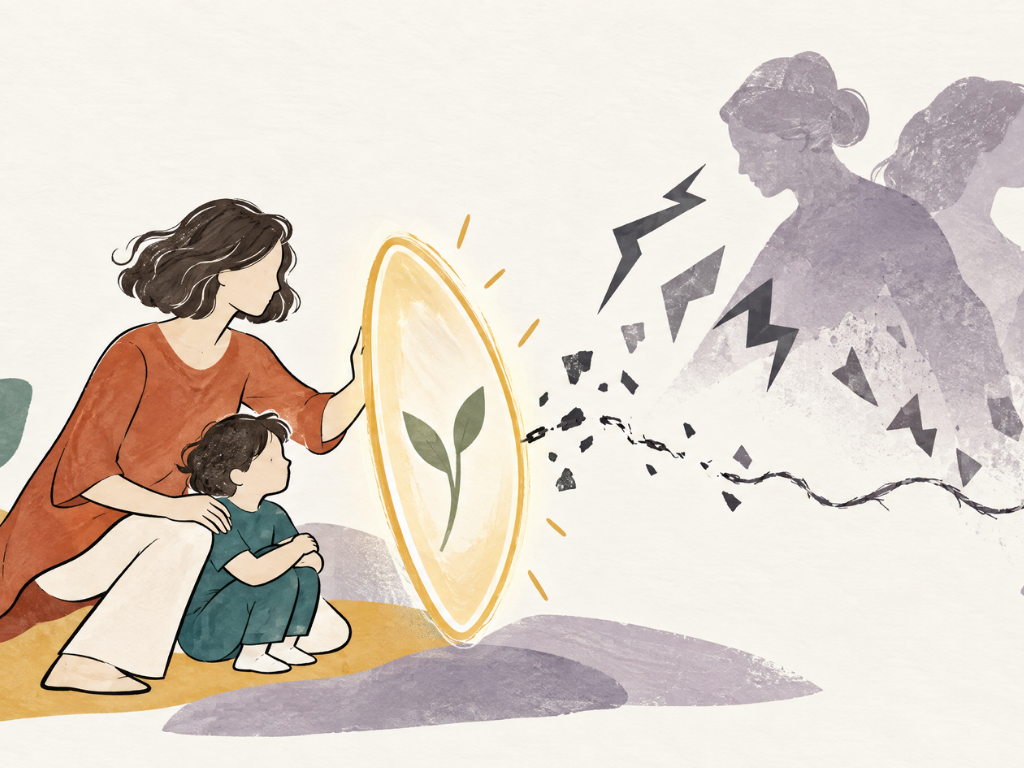
For many mothers, breaking the cycle begins with a deeply loving intention: to give their children something different from what they experienced themselves. But sometimes, that intention can become its own source of pressure.
The Quiet Vow Every Mother Makes
Most mothers I work with came into motherhood with the same quiet vow. I will not do to my child what was done to me.
It’s one of the most loving decisions a person can make. And for a lot of women, it slowly turns into something closer to surveillance. Every raised voice, every “no,” every ordinary hard moment gets pulled apart afterward and cross-examined. Did I just damage them? Am I becoming what I swore I wouldn’t?
For some mothers, breaking the cycle can start to feel like a responsibility to get everything right. Every mistake becomes something to analyze, every difficult moment something to question.
I want to draw a line between two things that look almost identical from the inside but aren’t the same at all. Conscious parenting. And perfect parenting.
What Conscious Parenting Looks Like
Conscious parenting is awareness in motion. You reflect, you notice your patterns, and you try to respond on purpose instead of on reflex.
There’s room in it for being human.
What Perfect Parenting Demands
Perfect parenting leaves no room for anything. It treats a single short temper, a single raised voice, a single moment you weren’t fully regulated, as proof that something in your child is now broken.
It turns parenting into a performance with no acceptable margin of error, instead of a relationship. One that, like every relationship, survives friction. Sometimes even needs it.
The Repair Matters More Than the Mistake
Here’s the part that tends to surprise people. Your child does not need a parent who never gets it wrong. What actually teaches a child that they’re safe isn’t the absence of hard moments. It’s a parent who gets it wrong sometimes and comes back, arms open, to make things right.
Children build trust through that cycle, not around it.
A parent chasing a flawless record isn’t shielding her child from harm. She’s shielding herself from guilt, which is a different project entirely, and a much lonelier one.
The Weight Nobody Warns You About
The vow to do better can quietly turn into something heavier than you meant it to carry: doubting every ordinary boundary the moment you set it, replaying arguments long after they’re over, aching for someone, a partner, a friend, a stranger online, to promise you that you are nothing like the parent who raised you.
And underneath it all, a quiet tension hums through the house that your child can feel in their small body, long before either of you has the words for what it is.
None of that makes you a better mother. It only makes you more worn down, more frightened, and children feel fear before they ever hear it spoken. They read the weather in a room long before they can read a sentence.
Reflection vs. Rumination
Here’s a simple way to tell which one you’re doing. After a hard moment, do you notice it, learn something small, and let it go? Or do you go back to it again and again, needing to punish yourself into feeling safe?
The first moves you forward. The second just feels like movement. From the inside, it can feel identical. It isn’t.
What Actually Breaks a Cycle
Breaking a cycle was never going to require a spotless record. No mother alive has raised a child without a hard evening, a sharp word, or a moment she wishes she could take back.
What actually breaks a cycle is smaller than that, slower than that, and far less dramatic: noticing when you slip. Turning back around. Staying close to your child, time after time, year after year, long after the hard evening is forgotten.
What refuses to fade isn’t the mistake. It’s that you kept coming back.
That’s the entire mechanism. It was never going to look like perfection, and it was never supposed to.
You are allowed to be an imperfect, still learning mother and still be giving your child something you may never have had yourself: a parent who comes back.
Not once. Not when it’s convenient. Every single time.
That was never a consolation prize. It was always, quietly, the whole point.
One day, your child will not remember the evening you got it wrong. They will not remember the raised voice or the sharp word. They will remember one thing, and it will become the ground they stand on for the rest of their life: that no matter what, you always came back to them.
Have advice for moms or a personal story to tell? We’d love to feature your voice on our blog! Share your experiences with us here! We’re always excited to welcome new perspectives and stories from moms like you!

Tatiana Khachan
Tatiana Khachan is a Licensed Clinical Psychologist and founder of NAFAS by Tatiana Khachan, a private psychology practice in Lebanon. She holds a Master’s degree in Clinical Psychology and a University Diploma in Systemic Therapy, with additional training in Cognitive Behavioral Therapy (CBT), Narrative Exposure Therapy (NET), and Psycho-Organic Analysis (APO). She works with children, adolescents, adults, couples, and families, integrating evidence-based and trauma-informed approaches according to each person’s needs