
My son lived for forty-five minutes.
Nothing could have prepared me for the reality of baby loss.
When I saw him for the first time, he was lying peacefully with one hand resting under his chin.
And he was beautiful.
The first thing I thought was not about statistics or survival rates. It wasn’t about gestational age or medical complications.
I looked at him and thought:
“That’s my baby.”
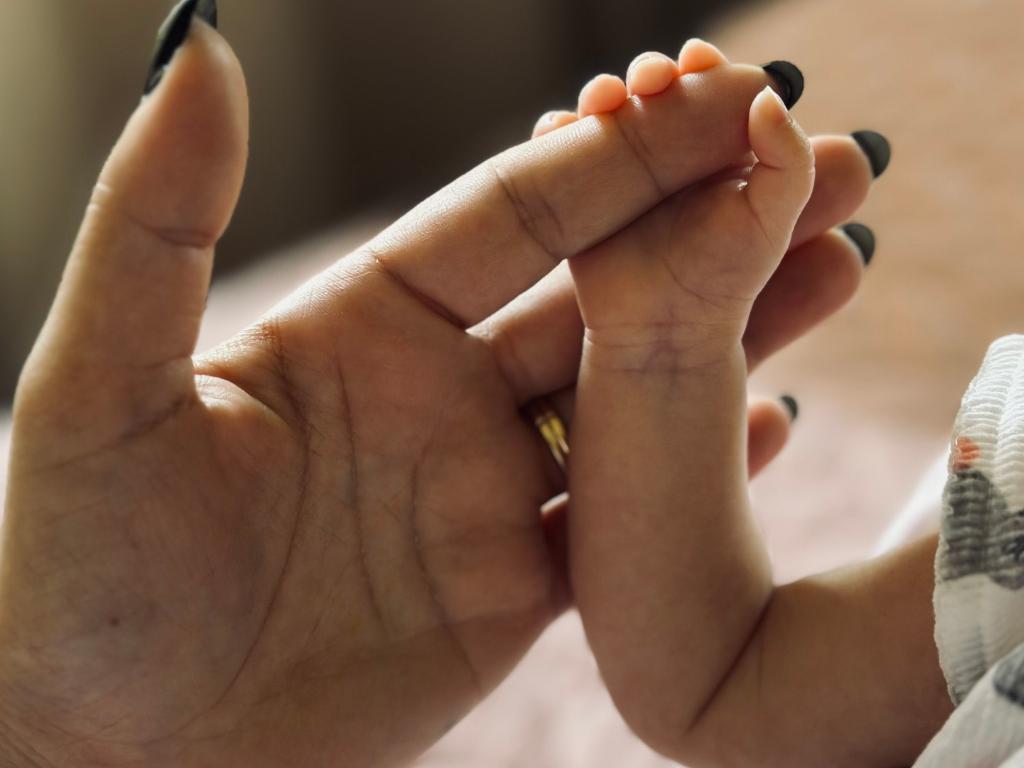
More than anything, I wanted to touch his tiny hand.
I wanted to hold him.
I wanted to place him on my chest and tell him how much I loved him.
But I wasn’t allowed to.
And if there is one question that has followed me throughout motherhood, it is this:
Why did I always need permission to hold my babies?
When Motherhood Began
Before Youssef, before Yasma, before all the hospitalizations and the grief, there was another baby.
My first pregnancy ended at eight weeks when the embryo stopped growing. I underwent a D&C and left the hospital believing I had experienced the greatest pain motherhood could bring.
At the time, I didn’t know that this baby loss was not the end of my story.
Instead, it was the beginning.
I had always wanted children.
In my mind, I imagined ordinary things: pregnancy photos, preparing a nursery, and counting down the days until meeting my baby.
I didn’t know then that motherhood would first teach me about hospitals, premature birth, NICUs, and grief.
When I became pregnant with Yasma, I thought life was finally giving me what I had dreamed of.
At twenty weeks, I started feeling pain.
It was a strange pain.
Back pain. Leg pain. Pressure.
Everyone told me it was normal.
But something inside me kept telling me otherwise.
Then, at twenty-six weeks, during what I thought would be a routine check-up, I saw my doctor’s face change.
One moment, he was saying everything looked good.
Next, he went silent.
Then he looked at me and said:
“Put your clothes on. Your cervix is open. We need to admit you to the hospital.”
Thirty-Five Days of Waiting
That day turned into thirty-five days.
People often say they were in labor for twenty-four hours. Forty-eight hours.
I was in labor for thirty-five days.
For thirty-five days, I lived with contractions.
There were thirty-five days of medication.
And thirty-five days of waiting.
Every night, I went to sleep wondering if I would wake up still pregnant.
Every morning felt like a small victory.
The hardest part wasn’t the pain.
It was the waiting.
The uncertainty.
And watching other mothers prepare for baby showers while I lay in a hospital bed, praying my daughter would stay alive for one more day.
But motherhood had already begun.
Motherhood doesn’t start when you meet your child.
Instead, it starts the moment you begin fighting for them.
Becoming a NICU Mother
After thirty-five days, I delivered Yasma through an emergency C-section under general anesthesia.
When I woke up, I didn’t care about anything except one question.
Is my baby alive?
She was.
But she was in the NICU.
I didn’t see her the day she was born.
When they wheeled me in the next day, I burst into tears.
She was so tiny.
Covered in wires.
Connected to machines.
I measured her body against my hands because I couldn’t believe someone so small could belong to me.
Five days later, I held her for the first time.
I felt like I was holding my heart outside my body.
People don’t understand what it means to become a NICU mother.
To leave the hospital without your baby.
To ask permission to touch your own child.
And to go home and pump milk while your newborn sleeps in a hospital instead of in her crib.
After thirty days, she came home.
And everyone thought the story was over.
But trauma doesn’t end when a baby leaves the NICU.
Instead, it follows you home.
It sits beside you while you feed them.
And it wakes up with you at night.
Motherhood Changed Me
Before becoming a mother, I thought motherhood was mostly about responsibility and sacrifice.
Today, I know it transformed me in ways I never imagined.
It didn’t make me someone new.
Instead, it introduced me to a part of myself I had never met.
It filled gaps in my identity, my purpose, my confidence, and my sense of belonging.
I thought I needed to heal before becoming a mother.
But motherhood itself became part of my healing.
Living Through Baby Loss
And somehow, when I least expected it, I became pregnant again.
Youssef was a surprise.
A beautiful surprise.
I thought now we knew the problem.
Now things would be different.
For the first time, I allowed myself to imagine what I had missed with Yasma.
A calmer pregnancy.
A full-term baby.
Two children close in age.
I imagined Yasma meeting her little brother.
Then, at sixteen weeks, I saw that look on my doctor’s face again.
The same silence.
The same fear.
My cervix was funneling.
Again.
This time, much earlier.
By twenty weeks, I was hospitalized.
This time, my husband couldn’t stay. We had an eleven-month-old daughter at home who needed her father.
So while I was fighting for one baby in the hospital, he was taking care of another baby at home.
And for the first time, I felt truly alone.
I lived from ultrasound to ultrasound.
Those few minutes became everything because they were the only moments I could see him alive.
Seeing him move.
Seeing his heart beating.
And seeing that he was still there.
Still fighting.
Still alive.
I loved him.
The day before I delivered him, something felt different.
No one had told me I was losing him.
But something inside me felt off.
I remember opening my phone and searching for how to tell the people I love that I had lost my baby.
Even writing those words now makes my chest tighten.
I wasn’t ready to lose him.
Yet somehow, a part of me was already trying to find words for the unimaginable.
The next day, at twenty-two weeks and four days, I gave birth to my son.
Without an epidural.
I felt everything.
He had my nose.
My lips.
His father’s facial shape.
Small strands of hair.
He was thirty centimeters long.
And he was sleeping peacefully with one hand resting under his chin.
I wanted to hold him more than anything.
As if a magnet were pulling him toward my chest.
As if every part of my body knew exactly where he belonged.
But I wasn’t allowed to hold him.
Instead, I watched him.
I memorized him.
Forty-Five Minutes
Two minutes later, I heard someone say they were taking him to the NICU.
Hope exploded inside me.
“He’s alive. He’s alive. Go ask. Do something.”
Then I learned the truth.
He wasn’t being taken there to survive.
He was being taken there to die peacefully.
Forty-five minutes later, the pediatrician came to my bedside.
“There is no heartbeat anymore.”
The world stopped.
And while my arms stayed empty, my body did what mothers’ bodies do.
A few hours later, my breasts became engorged.
My milk was coming in.
Every part of me knew I had given birth.
Every part of me was looking for my baby.
Except he wasn’t there.
Three hours later, they brought Yasma to the hospital.
I fed her a bottle and cried.
Because all I could think was that I should have been holding both of my babies.
Love and grief.
Together.
Not taking turns.
Existing at the same time.
When the World Moves On
The hardest part about neonatal death isn’t only losing your baby.
It’s watching the world continue while yours has stopped, and hearing people call it a miscarriage.
It’s the assumption that because you already have a child, you will eventually move on.
That another pregnancy will replace the baby you lost.
It doesn’t.
My husband also lost his son.
He buried his baby.
He carried grief differently, but he carried it too.
Fathers deserve space to mourn as fathers.
In our region, we are expected to carry everything quietly. To summarize pain into something manageable. Something that doesn’t make others uncomfortable. We were raised to be strong, to keep going, and not to burden others.
But silence doesn’t protect us.
It just leaves us alone with something too heavy to carry alone.
But Youssef existed.
I saw him, felt him, carried him, and gave birth to him.
I loved him.
And I will love him for the rest of my life.
I Am a Mother of Three
Today, I am a mother of three.
One baby I never got to meet.
One daughter who fought her way into this world.
And one son who lived for forty-five minutes and changed me forever.
I carried three babies.
My body remembers each one of them.
They all existed.
And they all changed me.
My story became my mission because I realized how many women are carrying stories of baby loss they never get to tell.
Opening my clinic wasn’t only a professional step.
It became part of honoring my son, my daughter, and every mother who feels alone in her experience.
I don’t believe suffering is a gift. But I know these stories deserve witnesses. They deserve space. And they deserve to be spoken out loud.
From One Mother to Another
If you are reading this from a hospital bed right now, I see you.
I’ve been there.
I know the waiting. I know the fear. And I know the loneliness.
You matter too.
Not only your baby.
You matter too.
Your story, the long, heavy, unedited version of it, deserves to be heard.
Because whatever you survived did not leave you unchanged.
Those scars are not just wounds.
They are the evidence of everything you carried, everything you lost, and everything you became.
I am a mother of three.
Even if you only see one.
Have advice for moms or a personal story to tell? We’d love to feature your voice on our blog! Share your experiences with us here! We’re always excited to welcome new perspectives and stories from moms like you!